IoT
OUR SERVICE
That is roughly how a textile manufacturer put it to us. They had bought an instrument, but the number moved every time they measured. They handle a wide range of products, and some sizes simply would not fit the machine at all.
So we built an instrument for their products specifically — from choosing the sensor, through putting the reading on screen, to keeping it as a record. All of it, in one machine.
Measuring is not the only thing we take on. Counting, telling one item from another with RFID, recording work automatically, raising an alarm the moment something goes wrong — we assemble whatever the job needs, from the ground up.
Further down this page you will also find our factory monitoring service, which puts the status of equipment you already own on an office PC.
A tension-and-extension instrument for a textile manufacturer
"We want to pull the material with a set force and measure how many centimetres it extends. Could you build something that does that?"
They had bought an instrument previously. The number moved from one measurement to the next, so the results could not be trusted, and with the range of textile products they handle, some sizes would not fit the machine. Hence the question of whether one could be made properly.
The photograph shows the instrument during development.
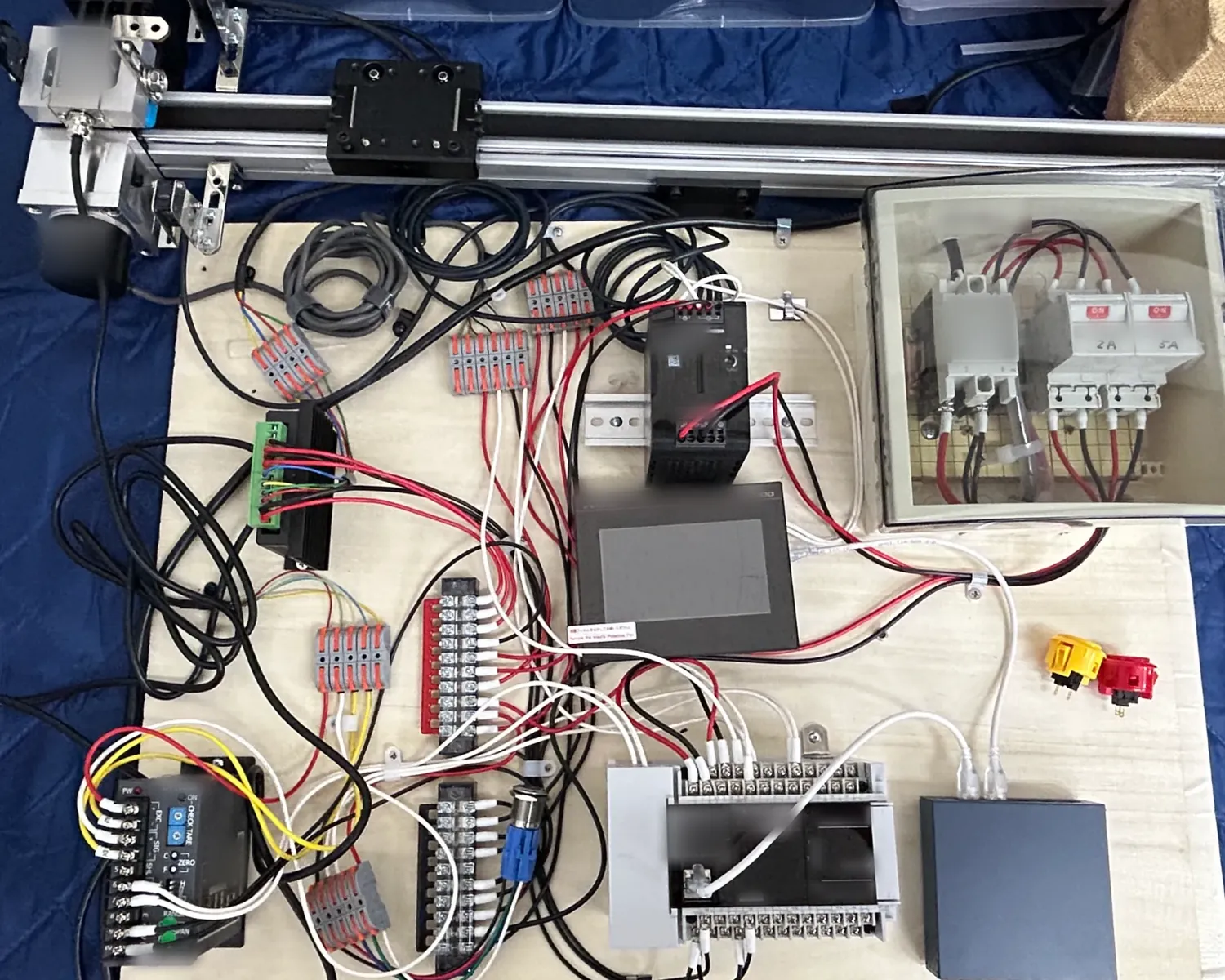
Delivered about six months after the first meeting.
Textile extends slightly differently each time it is pulled. Measure the same product repeatedly and the numbers will not match exactly.
That is not a question of the instrument's accuracy; it is a property of the material. The same thing happens with any instrument, however expensive.
Had we delivered without explaining it, the result would simply have been one more instrument nobody trusted. So we set out why the number moves, how many readings to take, and how to read them — and the instrument went into use on that understanding.
Fitting in every function we needed made the body larger than intended. It takes up more space than it should.
Next time we want to make it more compact, and we intend to say so to the client.
Delivery is not the end of it. Some things only become clear once a machine is in daily use, and improving it from there is the relationship we would rather have.
Under our confidentiality obligations, the client name, specification detail and actual figures are withheld.
How we work
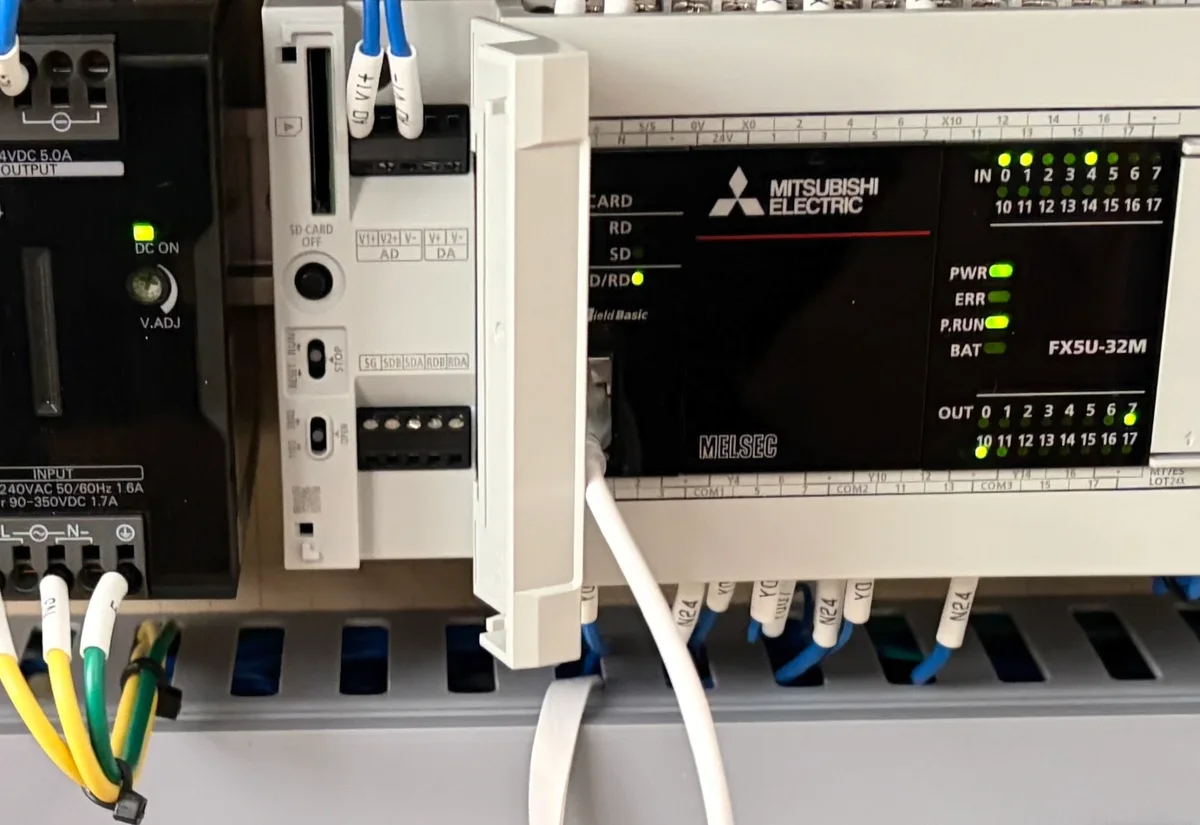
ONE STOP
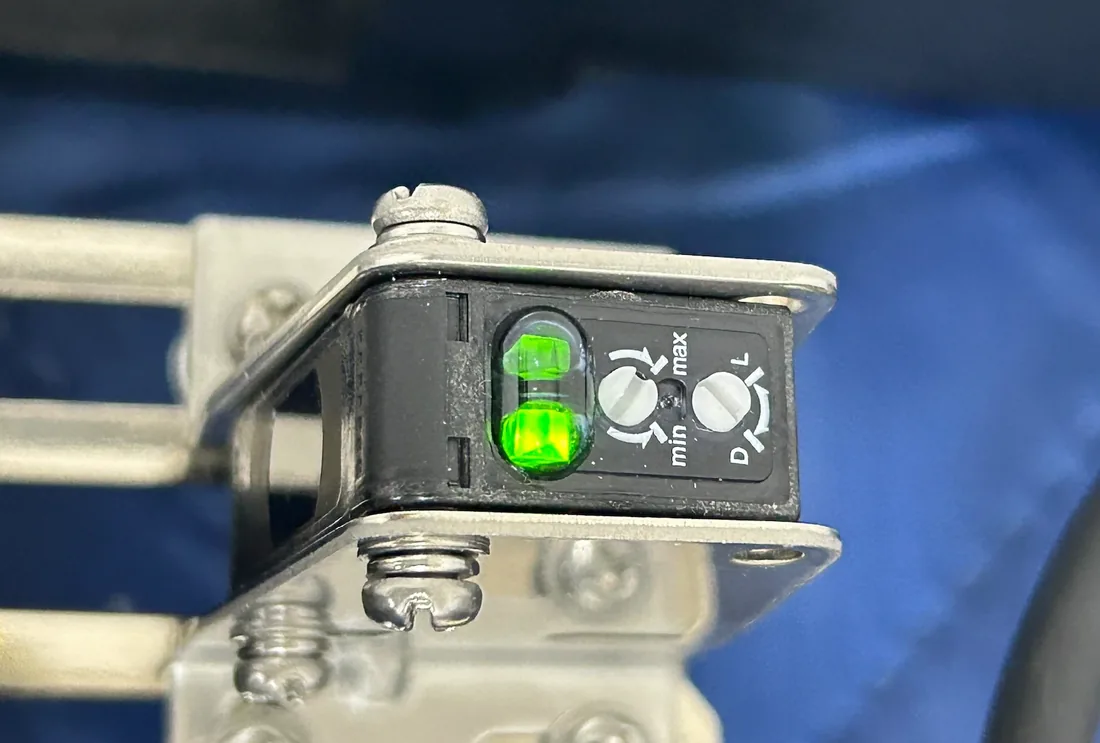
For this instrument we selected and combined components from different makers — PLC, touch panel, load cell, amplifier, encoder, power supply — and then built the screen and the recording as well. Where the electrical work and the software belong to two different firms, a machine like this has nowhere to be commissioned.
FIT TO YOU
Commercial instruments come with a fixed size and a fixed way of measuring. How wide does the range of your products go? How fine does the reading need to be? Can the person on the floor use it without hesitating? We start by asking what exactly did not fit about the one you bought.
HONEST
Building an instrument does not make everything measurable. Variation belonging to the material stays there whatever you do. We keep the two apart in the explanation: this part is the instrument's accuracy, this part is the nature of what you are measuring.
KEEP IMPROVING
Some things only show up once a machine is in use. It was bigger than expected; this operation turned out to be a nuisance. We want to hear that, and propose the next step from it.
If any of this sounds familiar, we can help

We bought an instrument and the numbers are not stable. Some products cannot be measured at all.
What we doWe establish what you need to measure and how finely, then build an instrument for it, starting from the choice of sensor.
We measure by hand and write it on paper. Afterwards nobody can tell who measured what, or when.
What we doWe build the record into the act of measuring, so the data can be checked and totalled later without anyone transcribing anything.
Somebody has to walk out to the floor every time just to see whether the machine is running.
What we doWe connect a small server to your existing equipment so the running status can be seen from a PC in the office.
Connect it to what you already have
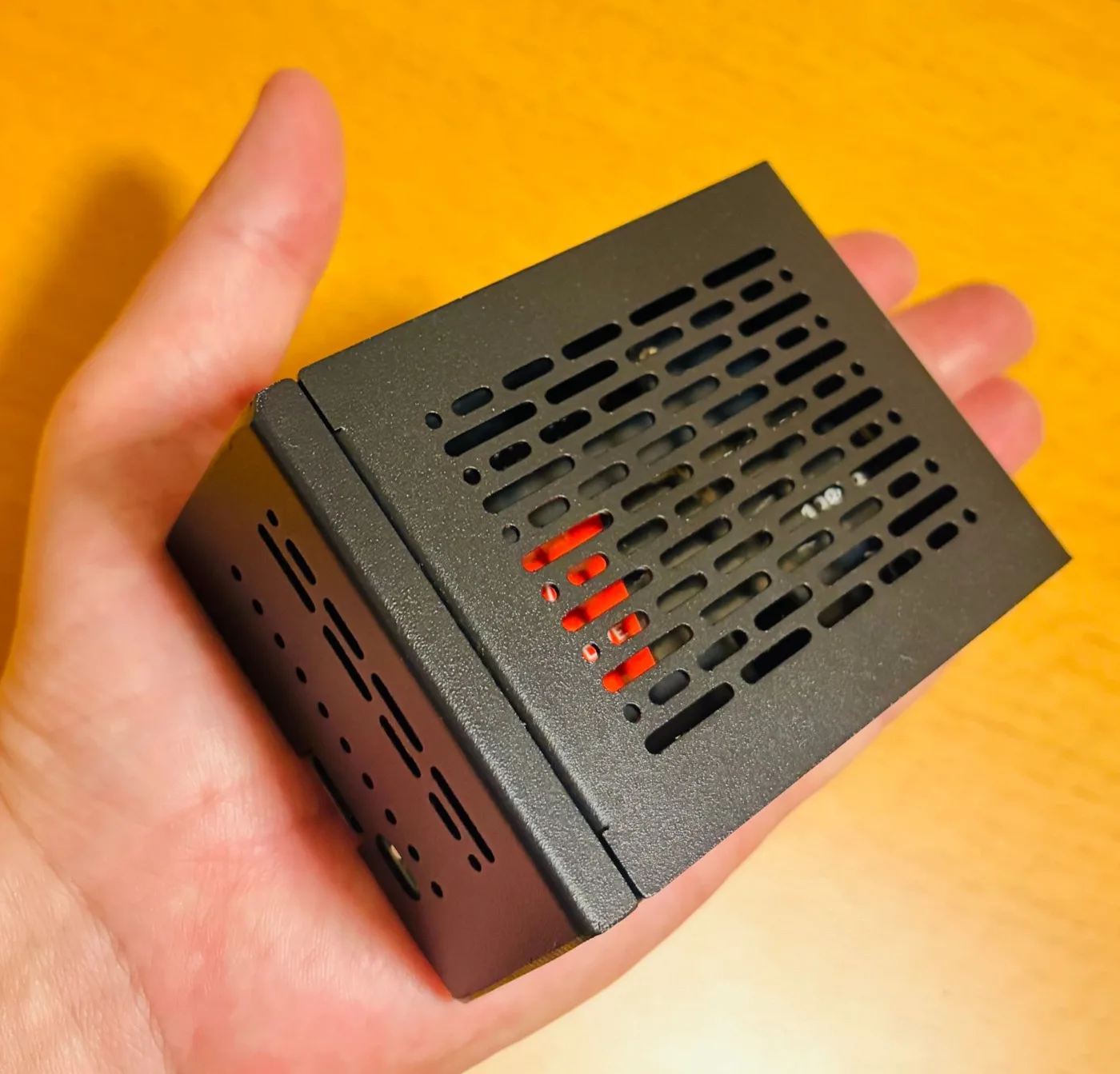
The photograph shows a server small enough to sit in your hand.
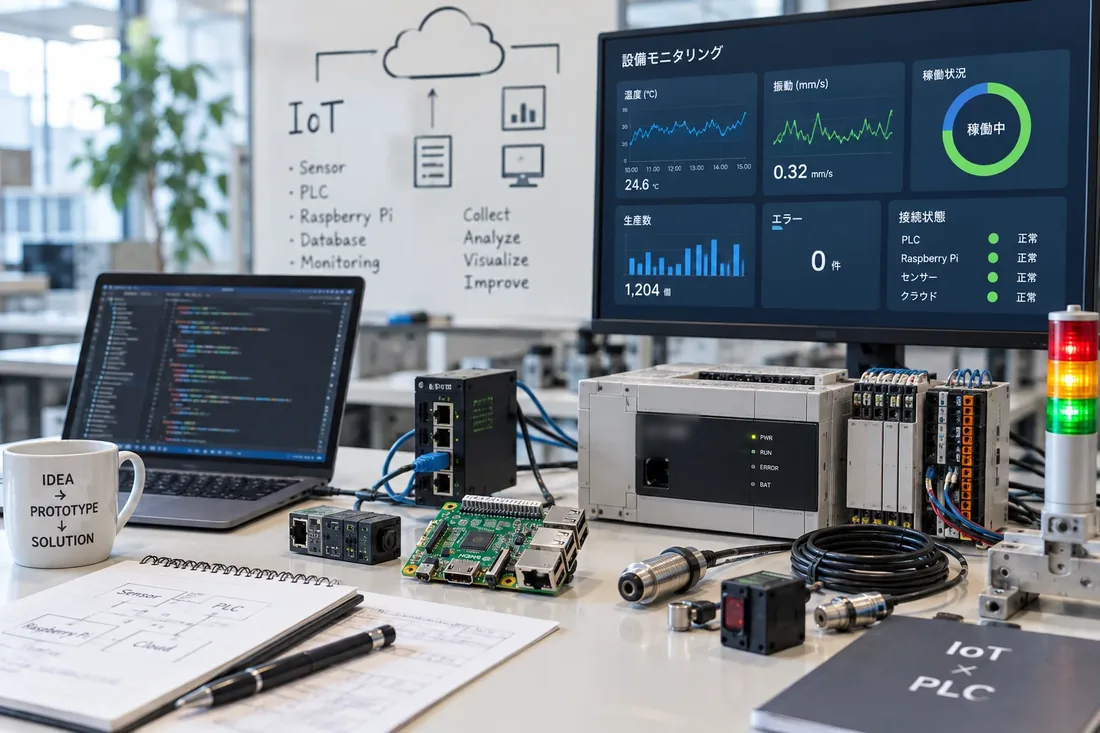
It goes in a spare space in the control panel and connects to the existing machine controller (the PLC) with a LAN cable. From there it reads what the PLC already knows and stores it automatically: whether the machine is running or stopped, how many units have been made, what the temperature is, and so on.
You look at it on the computers and phones you already use — the same screen you browse the web with — so there is no special hardware or software to buy. The data travels only within your internal network and never leaves for an outside cloud.
Existing PLC small server internal network PC or phone
PROCESS
Consultation
What people want on the floor is rarely only "measure this". Count it, tell one from another, keep a record, know immediately when something is wrong. Say it in your own words first — working out the shape of the solution is our side of the job.
These are the kinds of request we get.
The specification does not need to be settled. "Is this sort of thing possible?" is a perfectly good place to start. If you have tried a commercial product, what did not fit about it is the single most useful piece of information. The conversation is free.
Design & Verification
We settle on the sensor and the configuration and issue a quotation. Then we measure your actual product and firm up the specification while watching how the numbers behave. This is also the stage at which variation in the material itself becomes apparent.
Build & Improve
We build the machine and hand it over with an explanation of how to use it. The tension instrument took about six months from the first meeting. Whatever comes back from using it goes into the next one.
Frequently asked questions
Off-the-shelf instruments cannot measure our product. Would you build one for us?
Yes. For a textile manufacturer we built an instrument that measures how far a material extends when pulled with a set force. The measuring position can be adjusted to the size of the product, and every result is recorded. We handle it end to end — choosing the sensor, displaying the value on screen, and keeping the record — and deliver it as one machine.
Can you do more than measuring? We would also like to count things and keep records.
Yes. Counting with sensors, identifying products with RFID tags, recording work automatically, alerting a phone when something goes wrong — all of these are normal requests. The components change, but the shape of the job is the same as an instrument: take what happens on the floor, turn it into an electrical signal, record it, and make it visible. Tell us what you want to achieve and we will propose what fits.
We want an automatic count of how many we have made. How is that done?
It depends on what is being counted. For product moving along a line, a photoelectric or proximity sensor detects each item passing. Where the count is tied to a machine movement, that signal can be counted directly. If the equipment PLC is already counting, pulling that number out and recording it is the simplest and most reliable option. We look at the site and recommend whichever method is hardest to break and least likely to miscount.
Can RFID tags be used to identify products and keep a history?
They can. With a tag on the product, the jig or the pallet, simply passing it by a reader records which item it was, when, and which process it went through. That removes the transcription into paper records and makes items traceable afterwards. For some uses a barcode or QR code is sufficient. RFID is affected by metal and water, so we start by choosing the method that suits the environment you actually have.
Is there a way to know immediately when something goes wrong?
Yes. A signal tower or buzzer for people on the floor, email or a phone notification for anyone further away. What matters most is agreeing what counts as an anomaly, who should be told, and what happens at night and at weekends. Too many notifications and everybody stops reading them, so we work that out with you as part of the job.
How much can the measurements be trusted?
We choose a sensor suited to the use and test it on your actual product before delivery. What an instrument cannot remove, however, is variation belonging to the thing being measured. Textile, for example, extends slightly differently each time it is pulled, so measuring the same product repeatedly will not give an identical number. That is a property of the material. We explain this openly rather than leaving it to be discovered, and we set out how many readings to take and how to interpret them.
Will the parts be custom-made? We worry about what happens if something breaks.
We build from commercially available components wherever we can. On the tension instrument, the PLC and touch panel were Mitsubishi Electric, the load cell and amplifier came through a trading company, and the encoder and power supply unit were OMRON. Keeping custom parts to a minimum makes replacement straightforward and makes the machine easier to rebuild later.
How long does it take to have something built?
It depends on the content, but the tension instrument was delivered about six months after the first meeting. The sequence is: work out the requirements, select the components, test and confirm, then build and adjust. Tell us what you want to measure, how precisely, and on what kind of product, and we can give you a rough timescale.
Can we have changes made after delivery?
Yes. On the tension instrument, fitting in every function we needed made the body larger than we had intended. We want to make the next one more compact, and we intend to say so to the client. We work on the basis that some things only become clear once a machine is in use, and that it should be improved from there.
We have not decided what to build yet. Is it too early to talk?
Not at all — that is the best time. We listen to what is causing trouble, whether it is a job that is tedious every single time or a number that cannot be recovered afterwards, and we work out together whether something should be built at all and, if so, how far it should go. If the conclusion is that you do not need anything right now, that is a perfectly good outcome. The conversation is free.
Does factory monitoring require major installation work or modifying the equipment?
No. A server small enough to sit in your hand goes in a spare space in the control panel and connects to the existing PLC with a LAN cable. You view it on the computers and phones you already have, so there is no special equipment to buy. The one exception: if nobody knows which signals inside the PLC mean what, the ladder program has to be analysed first.
Related: ladder development and analysis/custom system development